Food Cost Percentage Formula: Cost a Dish in 5 Steps (2026)
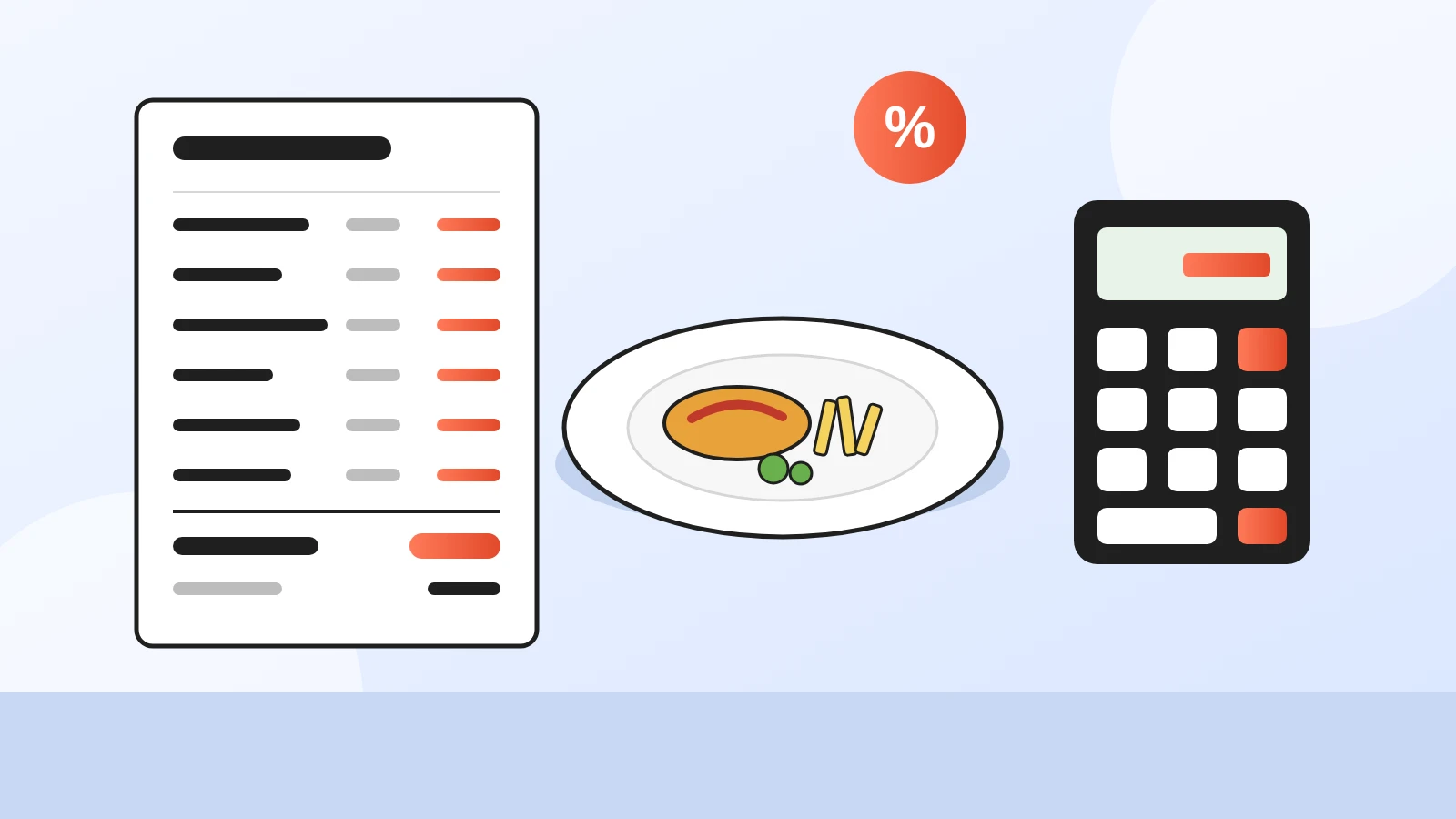
Food cost % = ingredient cost ÷ menu price × 100. How to cost a dish with a recipe cost sheet, set its price and keep the real number close to plan.
In this article
- The short answer
- What is the food cost percentage formula?
- How do I calculate the food cost of a dish?
- Example: costing a chicken sandwich
- How do I set a menu price from food cost?
- What is a good food cost percentage?
- Why is my real food cost higher than my recipe costs?
- How can food cost help me earn more?
- How do I keep menu prices up to date?
- Recipe cost sheet you can copy
Food cost percentage is the cost of the ingredients in a dish divided by its menu price, times 100. A burger that costs $4.00 to make and sells for $13.50 has a food cost of about 30%. The number tells you how much of every sale goes to ingredients, and what is left to pay for everything else.
This guide shows how to cost one dish line by line, how to turn that cost into a menu price, and how to check that your real food cost matches the plan.
What you'll get
- The three formulas you need, in one table.
- A recipe cost sheet you can copy into any spreadsheet.
- A worked example of a chicken sandwich, in dollars.
- How to find the gap between your recipe costs and your real food cost.
- Five ways to use food cost to earn more from the same menu.
The short answer
- Food cost % = plate cost ÷ menu price × 100.
- Menu price = plate cost ÷ target food cost. For a 30% target, divide by 0.30.
- Cost the whole plate: oil, sauce, garnish and sides included.
- Add trim and waste for anything you peel, bone or trim.
- Check the real number monthly with your inventory, not just your recipes.
What is the food cost percentage formula?
Food cost % is plate cost divided by menu price, times 100. These three formulas cover almost every pricing question:
| You want | Formula | Example |
|---|---|---|
| Food cost % of a dish | Plate cost ÷ menu price × 100 | $4.00 ÷ $13.50 × 100 = 29.6% |
| Menu price from a target | Plate cost ÷ target food cost | $4.00 ÷ 0.30 = $13.33 |
| Food cost % for a month | (Opening inventory + purchases − closing inventory) ÷ food sales × 100 | See the monthly example below |
The first two work dish by dish. The third tells you what really happened in the kitchen.
How do I calculate the food cost of a dish?
Build a recipe cost sheet: one line per ingredient, with what you paid and how much goes on the plate. Then add up the lines.
- List every ingredient, including the small ones: cooking oil, butter, sauce, garnish, the side.
- Write the price you pay and the unit you buy it in (per lb, per case, per dozen).
- Turn it into a unit price you can use: price per lb, per slice, per piece.
- Write how much goes on one plate, after trimming.
- Add the waste: multiply by a waste factor for anything you peel, bone or trim.
The waste factor is the weight you buy divided by the weight you can use. If 1.2 lb of chicken gives you 1 lb after trimming, the factor is 1.2.
Example: costing a chicken sandwich
The prices below are example numbers to show the method. Use the prices on your own supplier invoices.
| Ingredient | Price paid | Used per plate | Waste factor | Cost |
|---|---|---|---|---|
| Chicken breast | $4.80 per lb | 5 oz trimmed | 1.2 | $1.80 |
| Brioche bun | $4.80 for 8 | 1 bun | 1 | $0.60 |
| Cheese | $4.00 for 20 slices | 1 slice | 1 | $0.20 |
| Lettuce, tomato, onion | Estimated per plate | 1 serving | $0.30 | |
| Sauce and cooking oil | Estimated per plate | 1 serving | $0.20 | |
| Fries | $2.40 per lb | 6 oz | 1 | $0.90 |
| Plate cost | $4.00 |
With a 30% target, $4.00 ÷ 0.30 = $13.33. Round to a price that looks natural on the menu, like $13.50. That gives a food cost of 29.6%.
The 30% is only the target we picked for this example. Your own target depends on what your rent, staff and other bills need.
How do I set a menu price from food cost?
Divide the plate cost by your target food cost, then round to a clean price. After that, check the result against two things.
- Your guests. Would they pay it? Look at what similar places nearby charge.
- Tax. If your menu prices include sales tax, take the tax out before you work out the food cost. Otherwise the number looks better than it is.
If a dish can't reach your target at a price guests accept, change the recipe or the portion, not just the price. A smaller side, a cheaper garnish or a different cut can fix it.
What is a good food cost percentage?
There is no single right number. A steakhouse and a pizzeria have very different ingredient costs, and both can do well.
The useful question is: after ingredients, is there enough left to pay staff, rent and the bills, and still make a profit? Set your target from those numbers, then cost each dish against it. Some dishes will sit above the target and others below, and that's fine if the menu as a whole hits it.
Why is my real food cost higher than my recipe costs?
Your recipe costs assume perfect portions and zero waste. The kitchen never works like that, so check the real number every month with your inventory.
| Line | Amount |
|---|---|
| Opening inventory (start of the month) | $6,000 |
| Plus purchases during the month | $9,000 |
| Minus closing inventory (end of the month) | $5,500 |
| Food used | $9,500 |
| Food sales for the month | $30,000 |
| Real food cost | 31.7% |
These are example numbers. If your recipe costs say 29% and the real number is 31.7%, the gap is money lost to something in the kitchen.
The usual causes are:
- Portions that grow during a busy service. Weigh them, and give the line a photo of each plate.
- Waste and spoilage. Write down what gets thrown away, and why.
- Old recipe costs. A supplier raised a price and the sheet never changed.
- Staff meals and free dishes that nobody records.
How can food cost help me earn more?
Food cost tells you which dishes leave the most money after ingredients. Use it to steer what you sell, not only to set prices.
- Put your best earners where eyes land first: the top of each section, with a photo or a short line. Our guide to how many items to put on a menu shows how to sort dishes by sales and margin.
- Cost every size separately. A large portion rarely costs exactly twice the small one, so price each size from its own sheet.
- Watch half-and-half pizzas. In Acuolina a half-and-half pizza is charged at the average of the two halves automatically, so check that your most expensive pair still works at that price. More in our pizzeria and burger menu guide.
- Price delivery on its own. Packaging and app fees come on top of the plate cost. See why restaurants charge more on delivery apps.
- Bundle a high-margin side or drink with a popular main. More ideas in how to increase restaurant sales.
How do I keep menu prices up to date?
Change a price in one place and make sure every menu shows it. When prices live in several printed menus, they fall behind after the first supplier increase.
In Acuolina you edit the price once and the QR menu updates for every guest straight away. Each size of a dish can have its own price, and Download PDF on the Menus page prints that same menu with prices, allergens and the QR code. If you're starting from scratch, see our digital menu guide.
Recipe cost sheet you can copy
Copy this table into Google Sheets or Excel, one tab per dish. In the last column, use the formula: unit price × amount used × waste factor.
| Ingredient | Bought as | Price paid | Unit price | Used per plate | Waste factor | Cost |
|---|---|---|---|---|---|---|
| Plate cost | ||||||
| Menu price (before tax) | ||||||
| Food cost % |
Keep the sheets together with the supplier invoices, and update the price column every time an invoice changes.
Next step
- Sort your dishes by sales and margin: how many items should be on a menu.
- Selling on delivery apps? Read why restaurants charge more on DoorDash.
- Want more from each table? Try these ways to increase restaurant sales.
Ready? Create your free Acuolina menu and change prices in one place whenever your costs move. See what the paid plan adds, or find more practical guides in operations.
Frequently asked questions
What is the food cost percentage formula?
Food cost % = cost of the ingredients in a dish ÷ the price of the dish × 100. A dish that costs $4.00 to make and sells for $13.50 has a food cost of about 30%.
How do I calculate the food cost of one plate?
List every ingredient on the plate, including oil, sauce and garnish. For each one, multiply the price you pay per unit by the amount used, add the trim and waste, then add up the lines.
What is a good food cost percentage?
There is no single right number. It depends on your concept and your other costs: what is left after ingredients has to pay staff, rent and the bills and still leave a profit. Pick a target from your own numbers and track it every month.
How do I price a menu item from its food cost?
Divide the plate cost by your target food cost. With a $4.00 plate and a 30% target, $4.00 ÷ 0.30 = $13.33, which you can round to $13.50. If your menu prices include tax, take the tax out before you do the math.
Why is my real food cost higher than my recipe costs?
Recipe costs assume perfect portions and no waste. Real food cost also includes over-portioning, spoiled stock, staff meals and mistakes. Compare the two every month to find the gap.
How often should I update my recipe costs?
Whenever a supplier changes a price on an ingredient you use a lot, and at least every few months. Then check that the menu price still hits your target.
Keep reading
Operations
How Many Items Should Be on a Restaurant Menu? (2026)
A long menu feels generous but costs you in waste, prep time and slower orders. How many items to keep per section, and how to cut the rest with data.
Online ordering
Do Restaurants Charge More on DoorDash? Often, and Here's Why
Many restaurants price items higher on DoorDash and Uber Eats than in store. Where the difference goes and how to set fair app prices.
Restaurant marketing
How to Increase Restaurant Sales: 10 Practical Tips
Ten free, practical ways a small restaurant can sell more: a bigger average order, guests who come back, fuller slow days and direct orders with no commission.
Your first direct order, tonight.
Create your menu in minutes and get every Chef feature free for 14 days. Then stay on Basic for free, or upgrade.